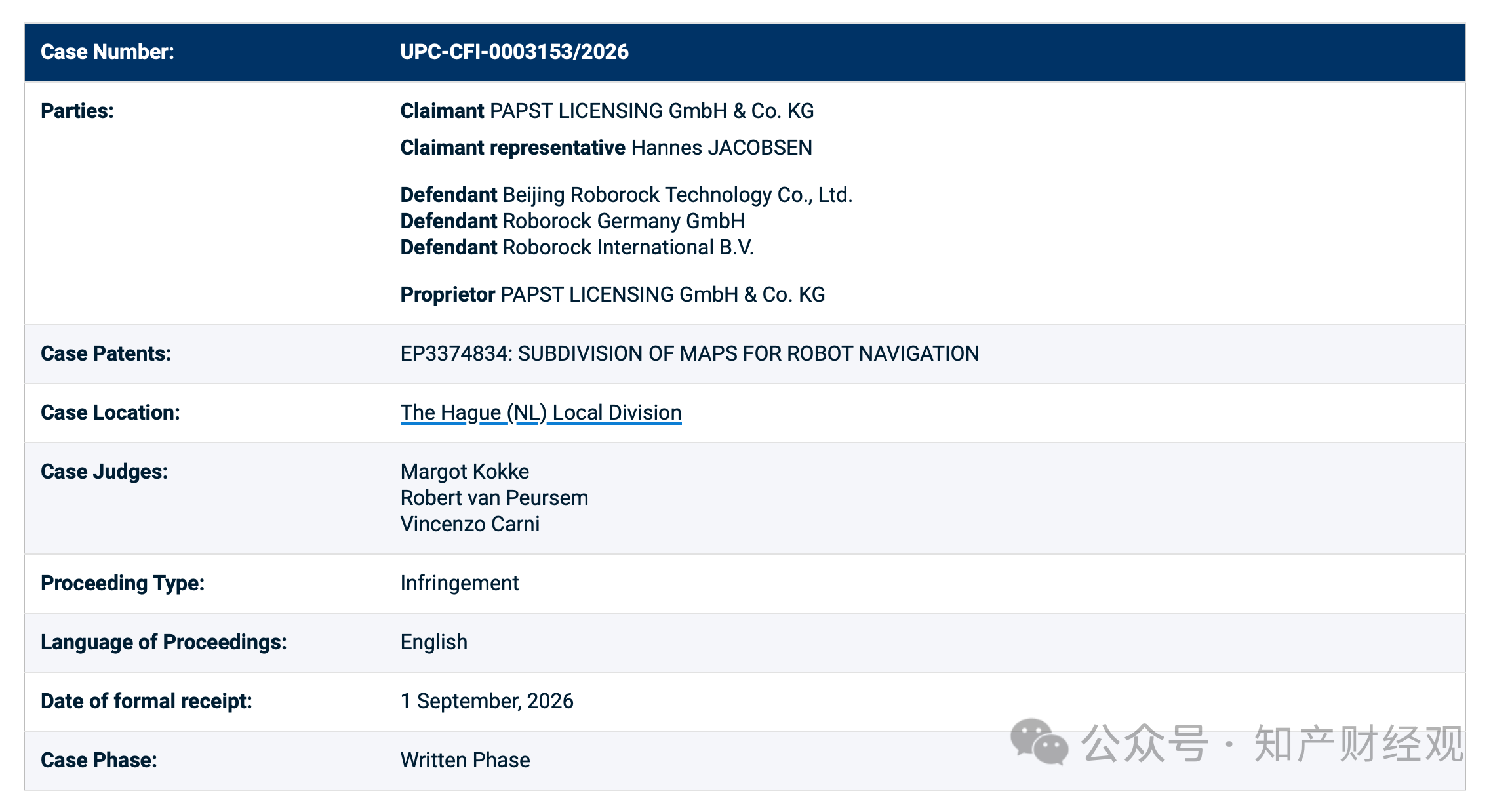
On September 1, 2026, just two weeks after German NPE PAPST LICENSING lost its case at the Munich Regional Division of the Unified Patent Court (UPC) on August 17, it filed another patent infringement lawsuit against Chinese robotic vacuum manufacturer Roborock at the UPC’s The Hague Regional Division (Case No.: UPC-CFI-0003153/2026).

Less than a month earlier, PAPST’s first offensive at the UPC had just suffered a setback. On August 17, 2026, the Munich Regional Division of the UPC ruled to dismiss all of PAPST’s infringement claims against Roborock, finding that products such as the Roborock S8 and Saros 10 did not infringe the European patent EP 3 030 943 at issue. UPC Finds that Roborock Did Not Infringe the Patent

In the previous case, the Munich Division adopted a narrow interpretation of the claims: the patent does not require a robotic vacuum cleaner to simply “know where it is,” but rather that the determination of “whether it is in a designated room” must directly determine whether the cleaning task continues—that is, an “IF…THEN…” relationship in program logic. After reviewing the actual test videos submitted by PAPST, the court concluded that the direct cause of Stone Technology’s products ceasing cleaning was “inability to reach the target room,” which falls under path planning and reachability issues, rather than the patent’s requirement to “stop upon entering the wrong room.” As the control logic differs between the two, no infringement was found. Since infringement was not established, the conditions attached to Stone Technology’s counterclaim for invalidation were not met, and the court did not address the issue of patent validity.

It is worth noting that PAPST did not accept this outcome. On the one hand, it filed an appeal with the UPC Court of Appeal on August 31 regarding the Munich judgment in the previous case; on the other hand, it filed a new lawsuit in the Hague Regional Division concerning the new patent. Unlike the previous case, the patent at issue in this litigation is EP 3 374 834, titled “Subdivision of Maps for Robot Navigation.” The basis for the infringement claim has shifted from the previous case’s “performing cleaning tasks based on room information” to the higher-level navigation infrastructure of “map subdivision.” The appeal and the new case are proceeding in parallel.

The previous case concluded at the Munich Regional Court with a narrower interpretation of the claims. This time, PAPST has opted for the Hague Regional Court and is invoking a new patent with different technical features, perhaps in an effort to circumvent the unfavorable interpretive framework established by the Munich Regional Court in the previous case. For Roborock, the victory in the prior case established a favorable precedent that “coordinate-based SLAM navigation is not equivalent to the patented room-matching logic.” However, since the new patent focuses on map partitioning technology, the two parties will once again engage in a battle over the interpretation of the claims. Meanwhile, Roborock is also facing multiple patent disputes in Europe from competitors such as Ecovacs, and patent wars among Chinese robotic vacuum manufacturers in the European market are intensifying.