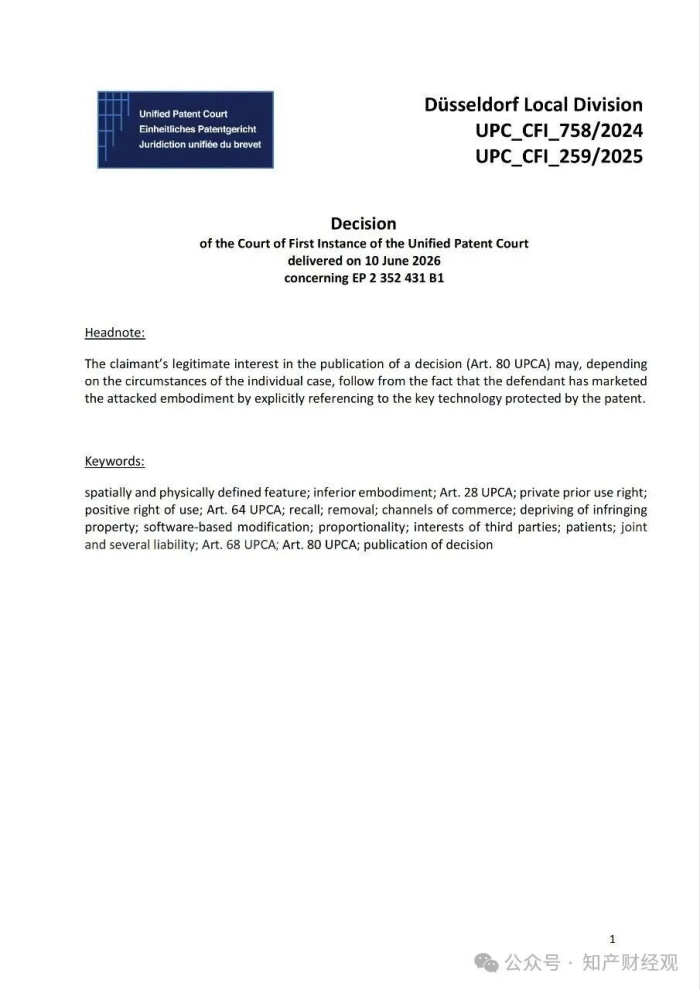
On 10 June 2026, the Düsseldorf Regional Division of the Unified Patent Court (UPC) delivered its judgment in the patent infringement dispute between Hologic and Siemens: Siemens Healthineers’ mammography device “MAMMOMAT B.brilliant” infringes European patent EP 2 352 431 B1 held by Hologic, dismissing Siemens’ counterclaim for patent invalidity. The court simultaneously issued an injunction and ordered Siemens to pay damages.
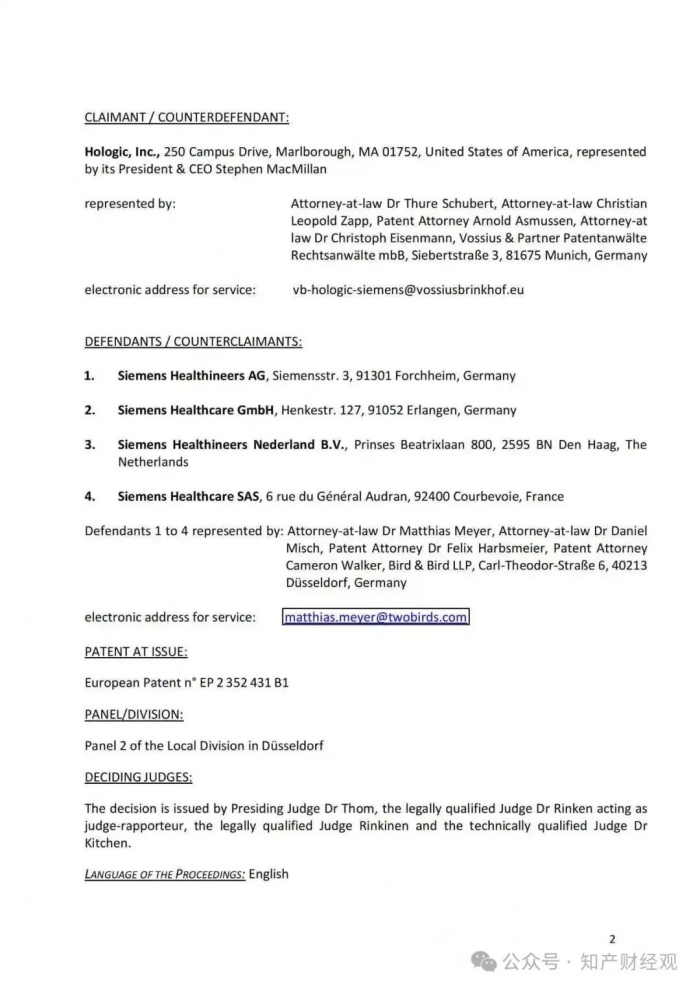
The defendants in this case comprised four Siemens entities: Siemens Healthineers AG (Germany), Siemens Healthcare GmbH (Germany), Siemens Healthineers Nederland B.V. (Netherlands) and Siemens Healthcare SAS (France). The court held the four defendants jointly and severally liable for the infringement.
The patent at issue relates to X-ray focal spot control technology in breast tomosynthesis imaging systems. The core of the technology lies in controlling the movement of the electron beam to create an “apparently fixed” effective focal spot during the X-ray tube’s moving exposure, thereby reducing motion blur and enhancing image quality.
The product at issue is the “MAMMOMAT B.brilliant” mammography system launched by Siemens at the end of September 2023. Hologic claimed that the product utilised the same “Flying Focal Spot” technical solution as the patent in question, constituting patent infringement; Siemens denied the infringement, whilst asserting prior use rights and active exploitation rights, and mounting a comprehensive challenge to the validity of the patent.
On the merits of the case, the court focused its discussion on the interpretation of the patent claims and the defence of the principle of proportionality. The court held that the “focusing cup” in the patent constitutes a technical feature with clear spatial and physical structural limitations, and cannot be simply understood as any device capable of performing a focusing function. The court also noted that, for device patents, a functional interpretation cannot supersede the specific structural limitations set out in the claims; otherwise, the boundary between literal infringement and equivalent infringement would become blurred. Accordingly, the court held that Siemens’ products fell within the scope of protection of the patent in question.
The court did not uphold Siemens’ argument that an injunction should not be granted. Siemens contended that, as the equipment in question is used for breast cancer screening and diagnosis, granting an injunction might adversely affect patients’ interests. However, the court noted that, in accordance with the principles of patent remedies under the UPC framework, an injunction remains the standard remedy in patent infringement cases. Siemens failed to demonstrate that no alternative mammography equipment exists on the market, nor did it prove that an injunction would result in patients being unable to access necessary screening or diagnostic services; consequently, the defence based on the principle of proportionality could not be upheld. Furthermore, the court rejected Siemens’ defences regarding prior use and active infringement, and dismissed all its grounds for invalidity, including claims of insufficient disclosure, addition of subject-matter, and lack of novelty and inventive step, thereby upholding the validity of patent EP 2 352 431 B1.
With regard to remedies, the court’s ruling included both approvals and rejections. The court upheld the injunction, the finding of liability for damages and the recall order, and required Siemens to disclose to Hologic information regarding the production, sale and distribution of the infringing products to facilitate the subsequent calculation of damages. Notably, the court explicitly rejected Siemens’ proposal to “eliminate infringement through software updates as an alternative to a recall”, on the grounds that, as a medical device manufacturer, Siemens retained full control over the firmware and updates and could not guarantee that the software modifications would be irreversible or that the products would not revert to an infringing state.
However, the court also partially dismissed Hologic’s claims. The destruction order applies only to the infringing products themselves; the request for the destruction of manufacturing tools was not upheld, as these tools are also used to produce other X-ray imaging products unrelated to the patent in question; the request for the destruction of advertising materials was also dismissed on the grounds that such materials do not fall within the scope of items subject to destruction under Article 64(2)(e) of the UPCA. The request for removal was dismissed as Hologic had failed to propose specific and clear measures, whilst the claim for provisional damages was not upheld as Hologic had failed to provide specific factual grounds sufficient to support the estimate.
Judgment attached
... ...