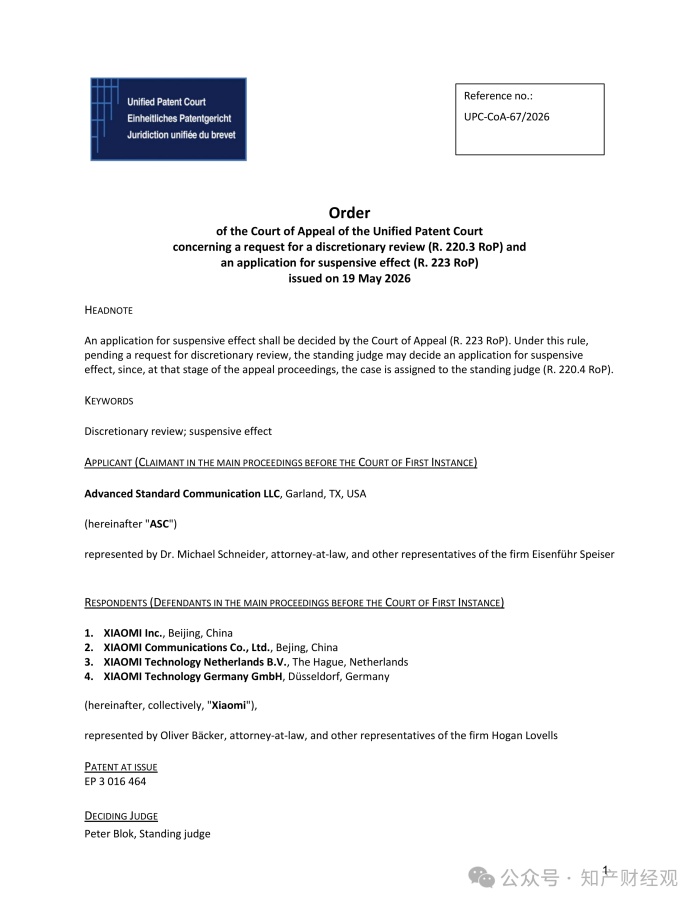
On 19 May 2026, the Board of Appeal of the Unified Patent Court (UPC) issued a ruling in the patent litigation between Advanced Standard Communication LLC (ASC) and Xiaomi: it dismissed ASC’s request for a discretionary review and its application for a stay of enforcement. The order previously issued by the Munich Regional Division requiring ASC to provide security for costs remains in force.
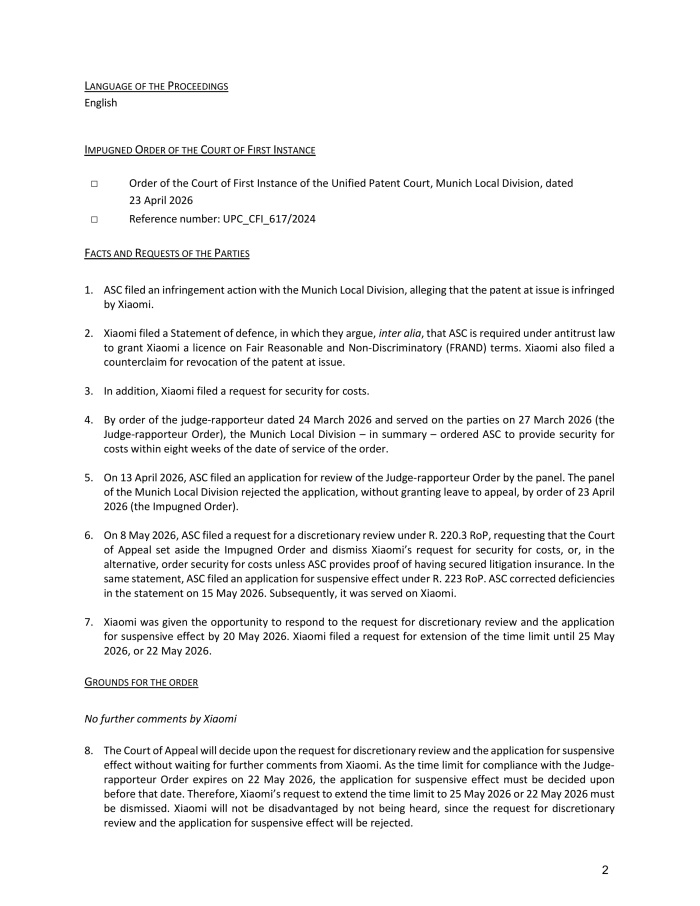
The case concerns European Patent EP 3 016 464. ASC had previously brought patent infringement proceedings against Xiaomi before the Munich Regional Division of the UPC, alleging that Xiaomi’s products infringed the patent in question. In its defence, Xiaomi raised several defences; in addition to asserting that ASC was under an obligation to grant a licence on FRAND terms, it filed a counterclaim for patent invalidity and further applied for ASC to provide security for costs.
In March 2026, the judge at the Munich Regional Division issued an order requiring ASC to provide security for costs within eight weeks of service. ASC subsequently applied for a review of the order by a panel of judges, but this was dismissed on 23 April, and the court did not grant leave to appeal. ASC then applied to the UPC Court of Appeal for a discretionary review and requested a stay of the obligation to provide security pending the review.
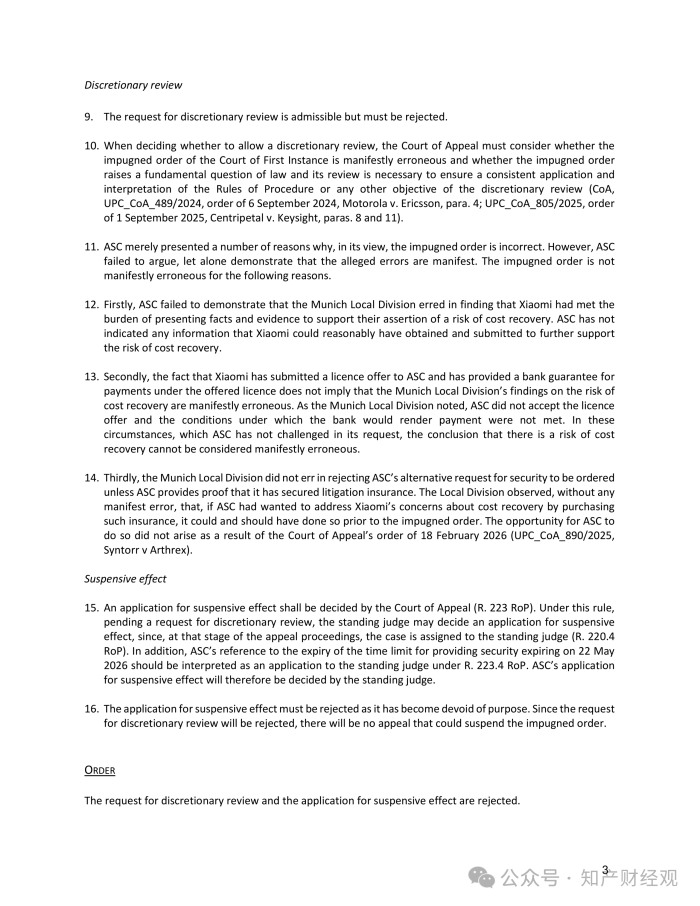
ASC put forward three main arguments. Firstly, it contended that Xiaomi had not sufficiently demonstrated the risk of being unable to recover the litigation costs; secondly, it pointed out that Xiaomi had submitted a licensing proposal to ASC and had provided a bank guarantee for its own payments under that licence, meaning there was no actual risk of non-recovery; thirdly, it argued that the court should at least allow it to substitute litigation insurance for the security measure.
However, the Court of Appeal did not accept these arguments. The court emphasised that a discretionary review does not constitute a retrial of substantive issues; it is granted only where the first-instance ruling contains a ‘manifest error’ or involves significant legal issues concerning the uniform application of procedural rules. ASC merely asserted that the first-instance ruling was erroneous without demonstrating that the error met the standard of a ‘manifest error’; consequently, the application for a discretionary review was dismissed. The Court of Appeal rejected ASC’s three core arguments one by one:
ASC failed to identify any reasonable alternative means by which Xiaomi could have supplemented the evidence to demonstrate a risk that the litigation costs could not be recovered; consequently, it could not be established that the first-instance court’s findings of fact were flawed;
Although Xiaomi submitted a licence offer and provided a corresponding bank guarantee, ASC did not accept this offer and the conditions for payment by the bank were not met; this circumstance cannot overturn the first-instance court’s finding regarding the risk of cost recovery;
Had ASC wished to substitute litigation insurance for the cost security, it should have proactively arranged the insurance during the first-instance proceedings, rather than raising the matter only after the order on security had been made; the first-instance court’s rejection of this alternative proposal did not constitute a manifest error.
As ASC’s application for discretionary review has been dismissed, there are no valid grounds for appeal that would suspend the enforcement of the original order; consequently, its application for a stay of enforcement has also been dismissed as having lost its substantive significance.
This ruling clarifies the UPC’s strict standard of review for procedural appeals. When a party applies for a discretionary review, it is insufficient merely to assert that the original ruling was ‘erroneous’; the party must demonstrate that the error was manifest, or that the case involves a significant legal issue concerning the uniform application of procedural rules.
Ruling attached