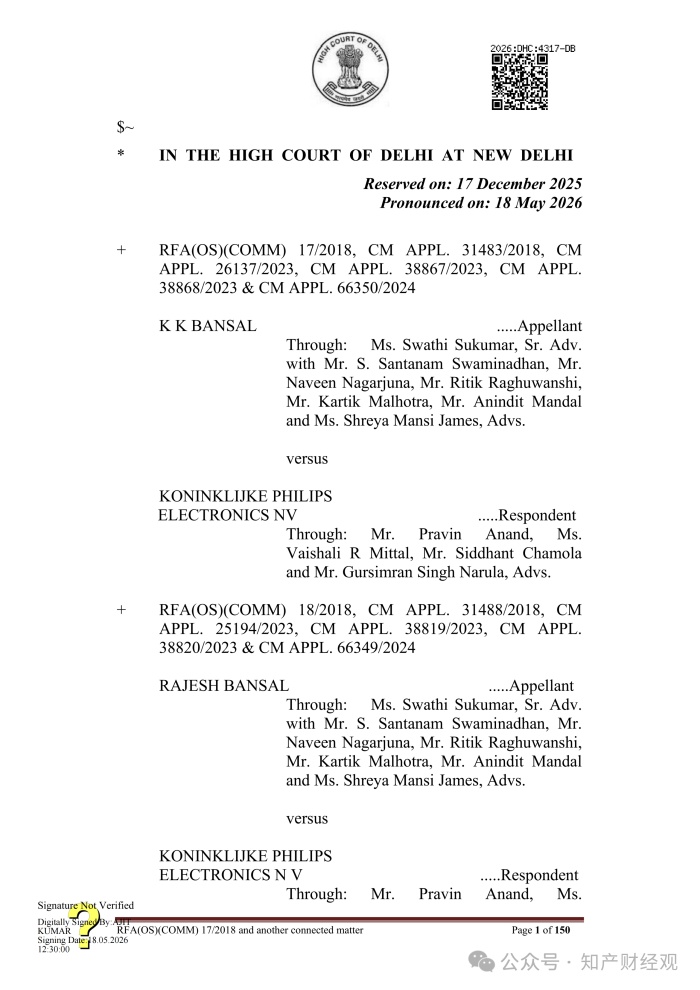
The Delhi High Court in India recently delivered a judgment on appeal in the dispute between Philips and Rajesh Bansal, K.K. Bansal and their associated companies concerning DVD standard essential patents (SEPs). The court set aside the first-instance judgment in favour of Philips and upheld the appeal filed by the Bansal party. The court held that Philips had failed to sufficiently demonstrate that the patent in question constituted a standard-essential patent (SEP), nor had it fulfilled the necessary technical burden of proof required for a finding of infringement. Furthermore, the court found that even on the assumption that the patent in question was an SEP and that infringement had occurred, Philips’s claims against downstream DVD manufacturers were precluded by the principle of international exhaustion of rights. Consequently, the first-instance rulings regarding FRAND royalties, liability for damages and punitive damages could not be upheld.
This case centres on Indian Patent IN184753, entitled “Decoding apparatus for converting modulated signals into a sequence of M-bit information words”. Philips argued that this patent corresponds to US Patent US5696505 and European Patent EP745254B1, both of which have been recognised as essential patents within the DVD technical standard; consequently, the corresponding Indian patent should also be regarded as an SEP. Philips further alleged that the DVD players manufactured and sold by Bansal incorporated the relevant technical solutions and infringed the patent without a licence.
Previously, the court of first instance upheld Philips’ claims, finding that the patent in question constituted an SEP within DVD player technology, and ordered the defendant to pay FRAND licence fees per DVD player: US$3.175 per unit for the period prior to 7 May 2010, and US$1.90 per unit for the period thereafter until the patent’s expiry date (12 February 2015). The court also awarded punitive damages of 500,000 rupees (5 lakhs) and ordered a further calculation of the number of infringing products.
At the appeal stage, Bansal raised several defences. Among these, he argued that the chips and PCB boards in the DVD players in question had been lawfully procured through authorised channels such as Sony, SANYO and MediaTek; therefore, even if the relevant technical solutions had been implemented, the principle of international exhaustion of patent rights should apply, and Philips had no right to continue to assert infringement claims against downstream DVD player manufacturers. The Delhi High Court ultimately accepted this argument. The court held that the patented technology in question was embodied in the chips and PCB components, and as the source from which Bansal procured these components had not been proven to be unlawful or unauthorised, even assuming that the patent in question was an SEP and that infringement had occurred, Philips’ patent rights had been exhausted once the relevant technical products had lawfully entered the market, and it was not entitled to continue to assert infringement claims against downstream manufacturers.
Furthermore, the court noted that in SEP infringement cases, the right holder is not merely required to prove the existence of the patent to obtain relief, but must satisfy multiple levels of proof, including the existence of the standard, the correspondence between the patent in question and the standard, the relationship between the accused product and the standard, and the reasonableness of the FRAND licensing terms.
In its judgment, the court cited the analytical framework from the case of Intex Technologies (India) Ltd v. Telefonaktiebolaget L.M. Ericsson, namely that if “the patent corresponds to the standard (A=B)” and “the product implements the standard (B=C)”, it can be further inferred that “the product implements the patent (A=C)”. However, the court emphasised that this inference is valid only on the premise that the right holder must complete the necessary technical mapping and provide factual evidence; infringement cannot be directly presumed merely on the basis that the patent claims to be an SEP. Philips failed to complete this process of proof in this case, and therefore its claim of infringement could not be upheld.
At the same time, the court adopted a cautious approach to the determination of FRAND rates. The court noted that an SEP rights holder must not only demonstrate that the rate is non-discriminatory, but also prove that it is “fair” and “reasonable”. The court emphasised that merely proving that all licensees are subject to the same rate is insufficient to demonstrate compliance with FRAND requirements; the commercial context of relevant third-party licence agreements, the terms of negotiation, and the factors underlying the rate’s formation are equally significant.
Overall, Philips’ defeat in this case was not solely due to insufficient evidence, but rather resulted from a judgment structure underpinned by three independent grounds: the determination of SEP status, proof of infringement, and international exhaustion of rights. Compared to the first instance, which derived liability for infringement and licensing more directly from the SEP status, the Delhi High Court, at the appeal stage, emphasised that SEP cases must still follow a comprehensive and rigorous path of technical and factual proof. This approach to adjudication may also influence how India handles future SEP disputes in areas such as 5G and the Internet of Things.
Attached Judgment:
... ...
Scan the QR code to access the full text of the judgment