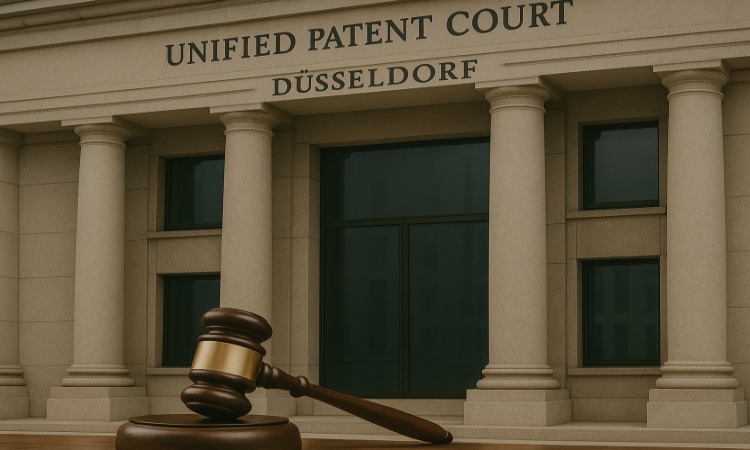
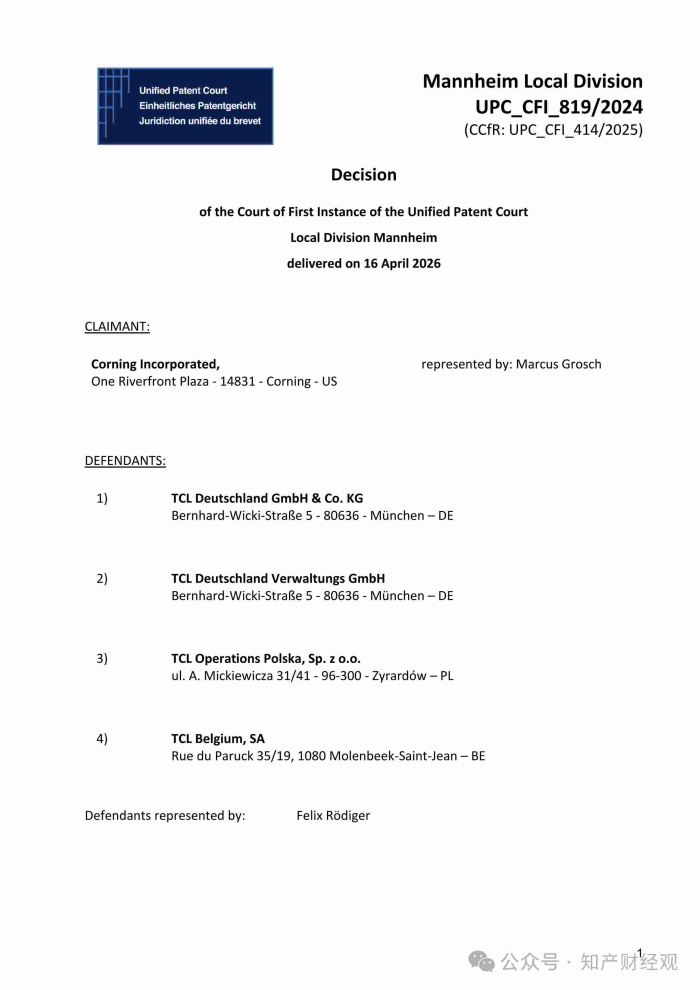
On 16 April 2026, the Mannheim Regional Division of the Unified Patent Court (UPC) delivered its judgment in the patent infringement case brought by Corning Incorporated against four TCL-affiliated companies (Case No. UPC_CFI_819/2024): The Court found that the glass substrates used in television products sold on the German market by three TCL entities in Germany fell within the scope of protection of Corning’s European patent EP 3 296 274, thereby constituting patent infringement. It upheld Corning’s key claims for an injunction, disclosure of information, product recall, channel clearance and destruction of stock, whilst dismissing TCL’s counterclaim for patent invalidity. Furthermore, the court found that TCL’s Belgian holding company did not infringe the patent and dismissed all of Corning’s claims against that entity.
Corning Incorporated, founded in the United States in 1851 and headquartered in Corning, New York, is a materials technology company specialising in the research, development, production and sale of specialty glass, ceramics and related materials. Its business spans the fields of display technology, optical communications, consumer electronics, life sciences, and automotive and environmental protection.
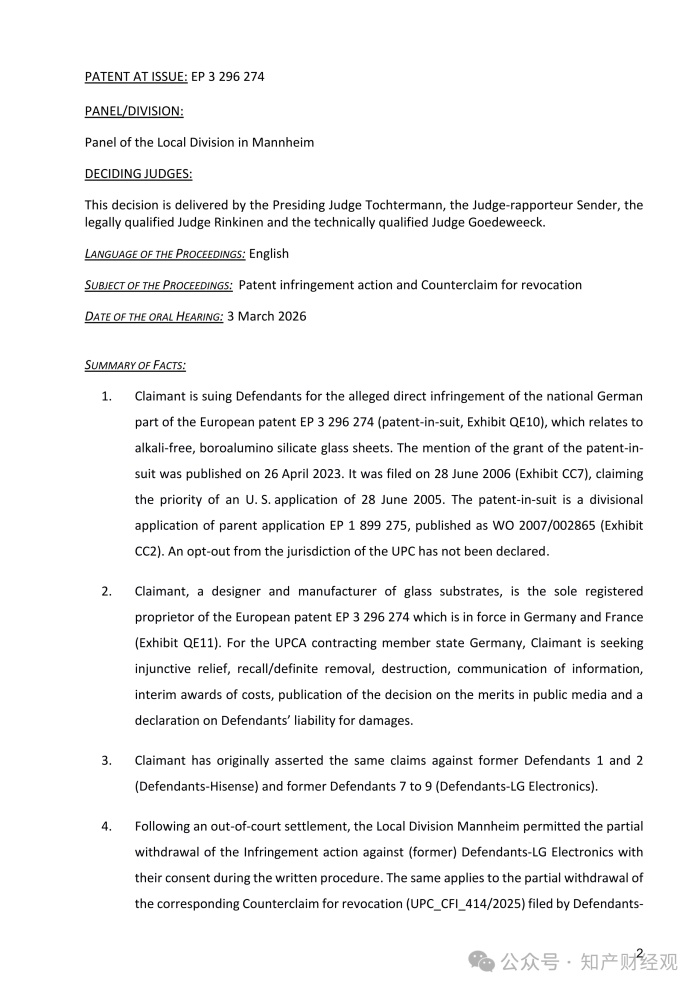
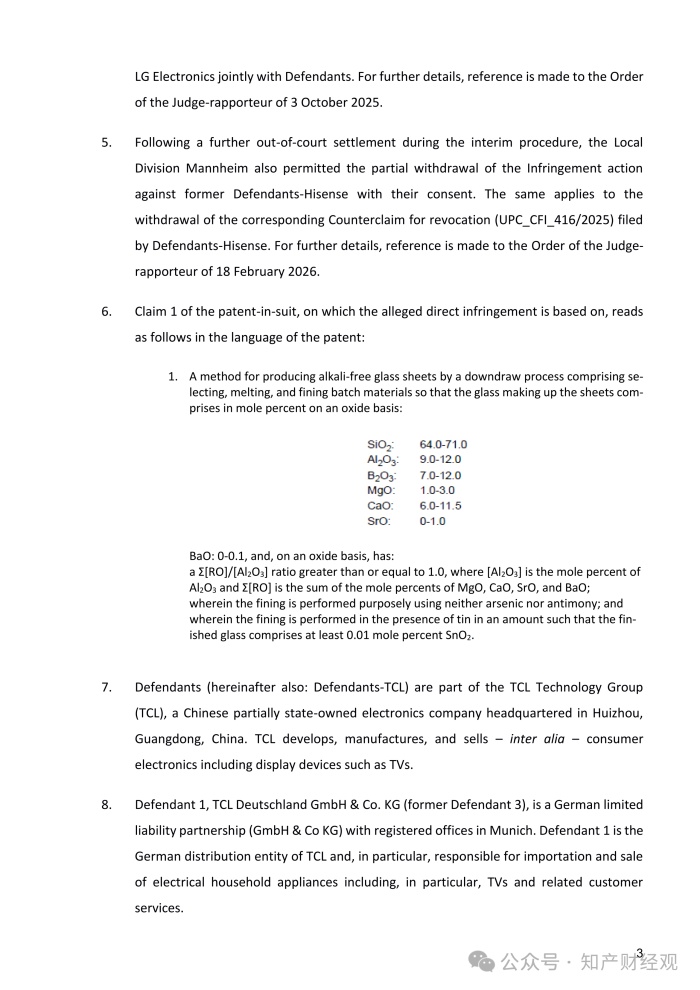
The patent at issue in this case, EP 3 296 274, is a European patent held by Corning that protects a method for manufacturing alkali-free borosilicate glass sheets. The patented technology is primarily applied to substrate materials for liquid crystal display (LCD) panels. The innovation of this patent lies in the preparation of glass substrates via the downdraw process, combined with a specific oxide composition ratio, using tin dioxide (SnO₂) to replace traditional arsenic and antimony as refining agents. This approach not only meets the stringent requirements of display panels for high flatness, thermal stability and chemical stability in glass substrates, but also mitigates the environmental and health risks posed by arsenic and antimony-based toxic refining agents.
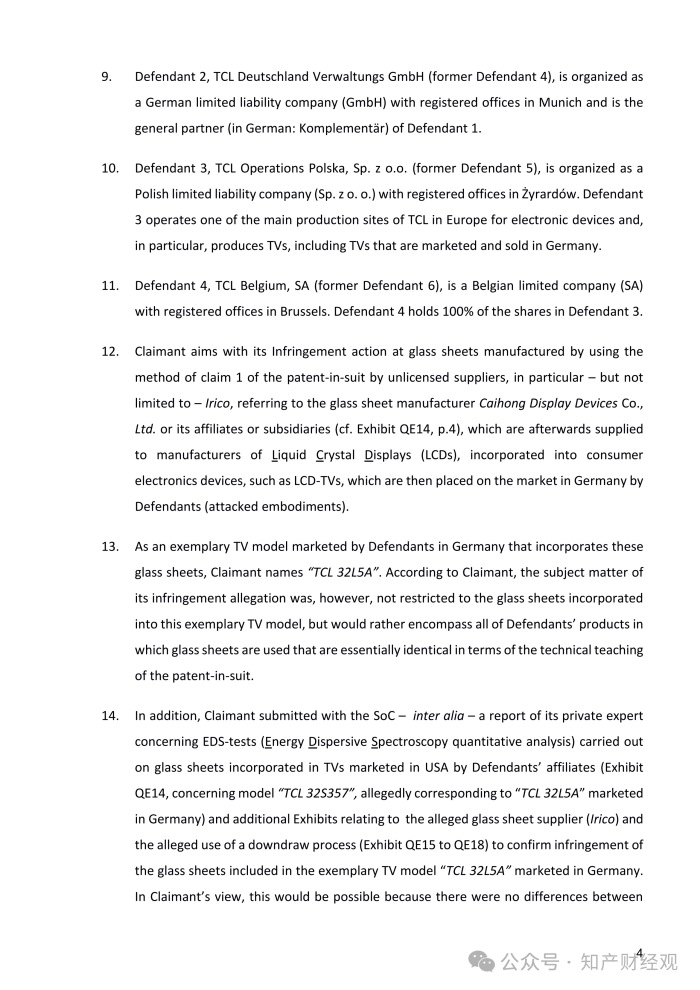
In 2024, Corning filed a patent infringement lawsuit with the Mannheim Regional Court of the Unified Patent Court (UPC), naming four European subsidiaries of TCL in Germany, Poland and Belgium as defendants. Corning alleged that LCD television products sold by TCL in the German market incorporated glass substrates manufactured by Irico Display Components Co., Ltd. using the patented method in question, thereby constituting direct patent infringement. During the proceedings, Hisense and LG Electronics—initially named as co-defendants—reached out-of-court settlements with Corning, and the court granted Corning’s motion to withdraw the claims against these two parties.
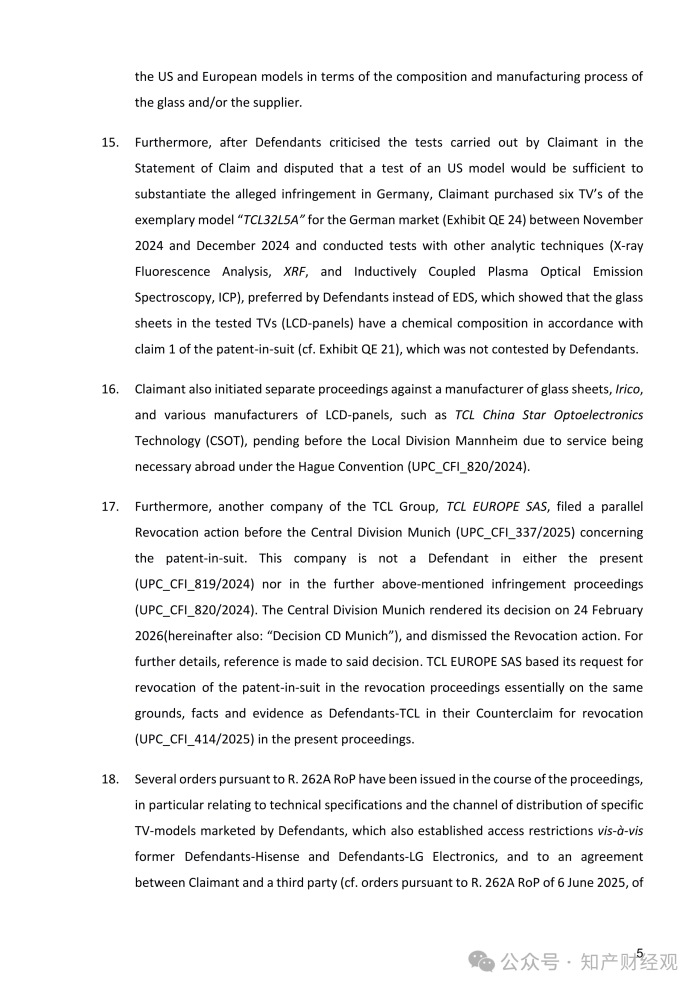
In this case, according to the published judgment, the court first determined that Corning had provided sufficient evidence of the infringement. Corning first conducted chemical composition testing on the US-specification model corresponding to the TCL 32L5A television sold in the German market. Subsequently, in response to TCL’s defence that ‘the test results for the US model cannot prove infringement of products in the German market’, Corning procured a further six TCL 32L5A televisions sold in the German market and employed two testing methods—X-ray fluorescence spectroscopy (XRF) and inductively coupled plasma emission spectroscopy (ICP) – methods approved by TCL – to demonstrate that the chemical composition of the glass substrates used in the televisions in question falls entirely within the scope of protection of claim 1 of the patent in question; Furthermore, the court clarified that even if the glass substrates in question were supplied by a third party not a party to the proceedings, TCL would still be infringing the method patent in question provided that it incorporated glass substrates directly manufactured using the patented method into television products and engaged in acts such as selling or offering to sell them on the German market.
Secondly, regarding the various defences raised by TCL during the proceedings, the court examined each one individually and dismissed them all. Regarding TCL’s defence that “the testing samples were insufficient”, the court found that Corning had fully discharged its burden of proof by supplementing the testing of models sold on the German market; regarding TCL’s defence that “its currently manufactured products no longer infringe”, the court held that a unilateral statement alone could not rebut the presumption of a risk of repeated infringement arising from the prior infringement; furthermore, TCL had not submitted a commitment to cease infringement containing punitive clauses, and therefore this defence could not stand; Regarding TCL’s defence of “exhaustion of rights”, the court clarified that Corning’s infringement allegations were directed solely at glass substrates produced by unauthorised suppliers; Corning’s own glass production was never within the scope of the infringement allegations in this case, and this defence had no factual basis.
Consequently, the court ultimately upheld Corning’s core claims, finding that the two TCL entities in Germany responsible for import and sales in the German market, and the TCL entity in Poland responsible for European manufacturing, had jointly committed the infringement and should bear full liability for the infringement. However, as the TCL holding company in Belgium was merely a shareholder, and Corning had failed to prove that it exercised actual operational control over the infringing acts of the Polish subsidiary, it was not held liable for the infringement.
With regard to the three liable TCL overseas entities, the court ordered: Firstly, to immediately cease all infringing activities within Germany, including the offer for sale, sale, use, importation and storage of the infringing products for the aforementioned purposes; Second, within six weeks of the judgment being served, to disclose to Corning, in the form of an electronic spreadsheet, full details of all infringing products since 27 May 2023, including supply chain sources, sales channels, production and sales volumes, transaction prices, third-party participants, advertising activities, and a breakdown of costs and profits, accompanied by relevant transaction documentation; Thirdly, recall all infringing products placed on the market since 26 April 2023 through commercial channels, completely remove such products from the distribution channels, and destroy any infringing products held in its own inventory; in the event of a breach of the aforementioned injunctions, disclosure obligations, or recall and destruction obligations, a punitive damages payment of up to EUR 100,000 per day shall be payable.
Attached: Judgment
...
Scan the QR code to access the full text of the judgment