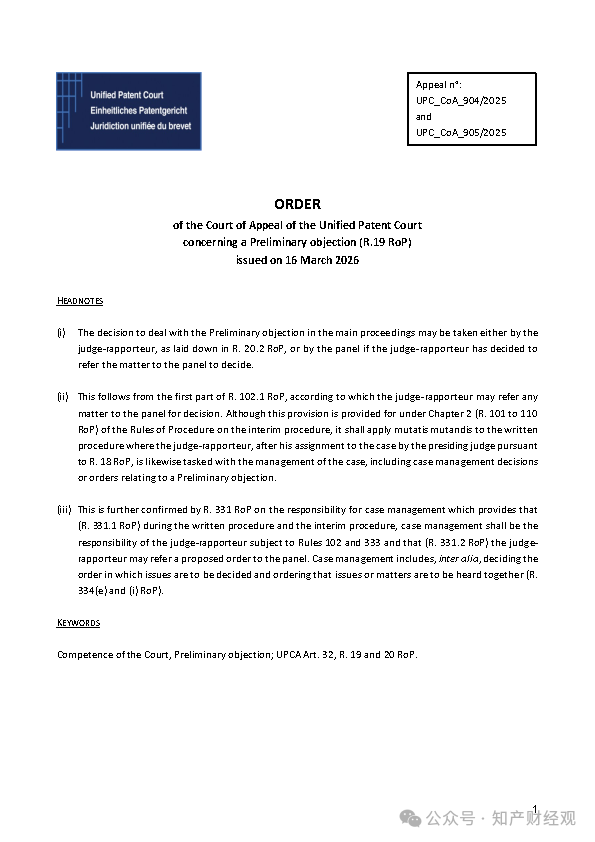
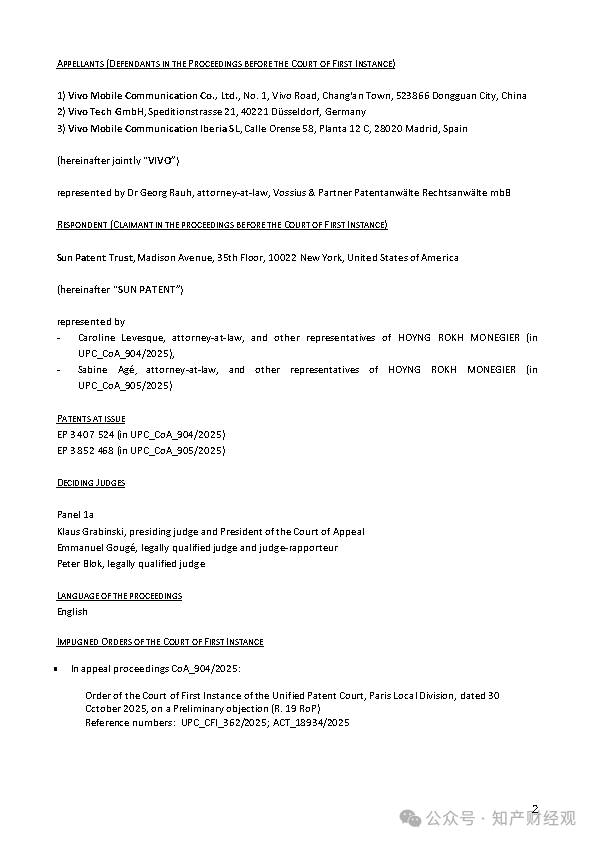
On March 16, 2026, the Board of Appeal of the Unified Patent Court (UPC) issued a ruling in the standard-essential patent (SEP) dispute between Vivo Mobile Communication Co., Ltd. et al. and Sun Patent Trust, dismissing two appeals filed by Vivo and upholding the earlier decision of the Paris Regional Division regarding preliminary objections.
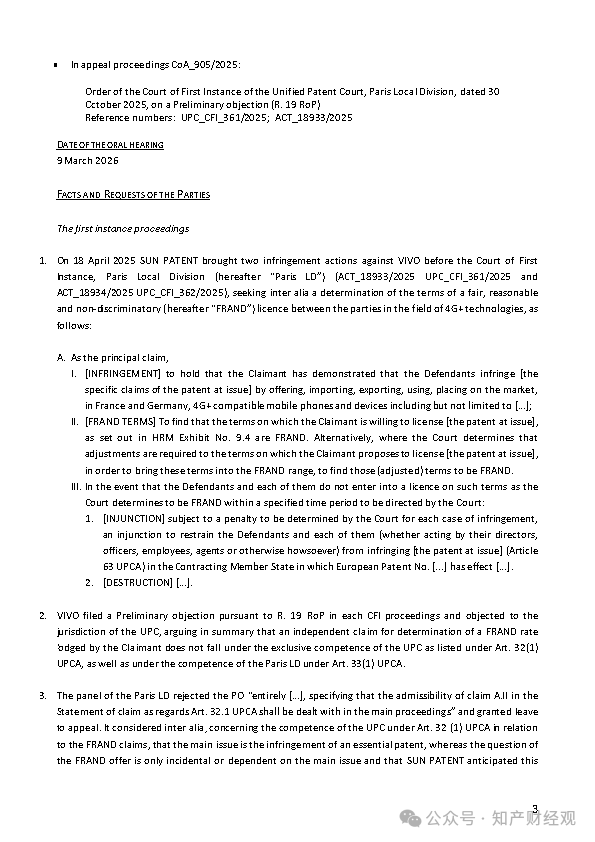
The case originated in April 2025, when Sun Patent Trust filed an infringement action against Vivo at the UPC Paris Regional Division based on two European patents (EP 3 407 524, EP 3 852 468) at the UPC Paris Regional Division, alleging infringement of its 4G+-related standard-essential patents. Sun Patent Trust requested the court to confirm that its proposed licensing terms complied with the “fair, reasonable, and non-discriminatory” (FRAND) principle and sought an injunction in the event the defendant refused to accept the terms.
In response to these allegations, Vivo filed a preliminary objection pursuant to Article 19 of the UPC Rules of Procedure, arguing that the plaintiff’s request for a determination of FRAND licensing terms constituted an independent claim that fell outside the exclusive jurisdiction provided for in Article 32 of the Agreement on the Unified Patent Court (UPCA), and that the UPC lacked jurisdiction to hear the matter. In October 2025, the Paris Regional Chamber ruled to dismiss the preliminary objection and decided to defer the issue of the admissibility of the FRAND clause request to the substantive proceedings, while granting leave to appeal.
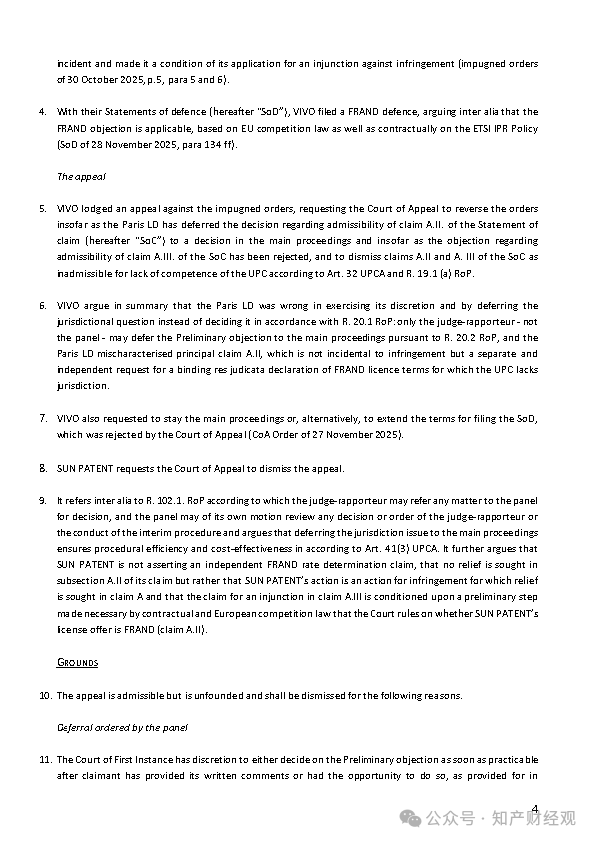
In the appeal proceedings, Vivo argued that the court of first instance had erred in the application of procedure, contending that only the presiding judge had the authority to decide whether to defer the preliminary objection to the substantive hearing stage, and that the panel’s direct decision on this matter exceeded its jurisdiction; simultaneously, Vivo maintained that the request for FRAND terms was independent and should have been deemed inadmissible at the outset of the proceedings.
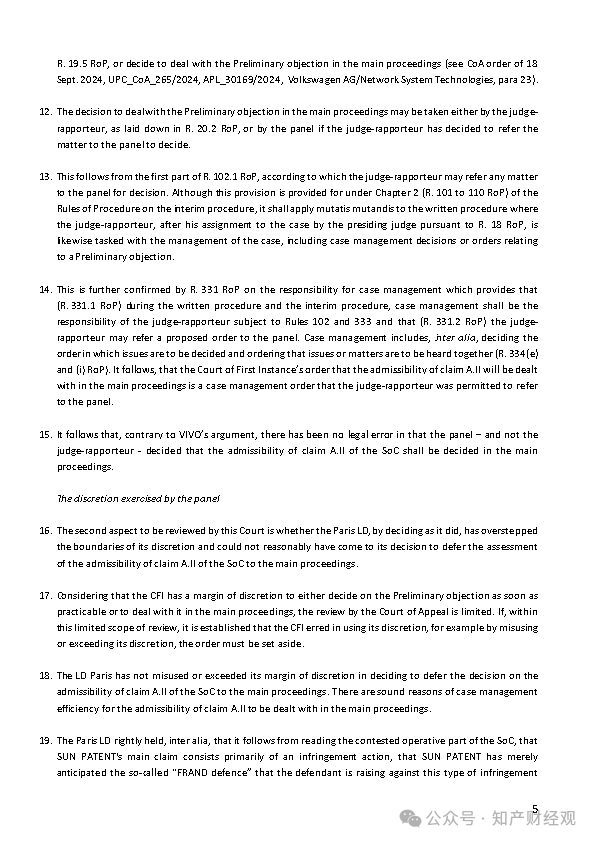
In response, the UPC Court of Appeal explicitly stated that, pursuant to Rules 102 and 331 of the Rules of Procedure, the presiding judge has the authority to refer relevant matters to the panel for decision, and the panel may also issue case management orders, including determining the order in which different issues are heard. Therefore, the panel’s decision to consolidate the preliminary objection with the substantive proceedings did not constitute a procedural violation.
On the merits, the Court of Appeal further held that the trial court did not exceed its discretion in exercising its authority. It emphasized that, based on the overall structure of the complaint, Sun Patent Trust’s core claim remained the finding of patent infringement, while the confirmation of the FRAND terms served merely as a prerequisite for obtaining an injunction. As such, it constituted an ancillary issue subordinate to the infringement claim, rather than an independent cause of action.
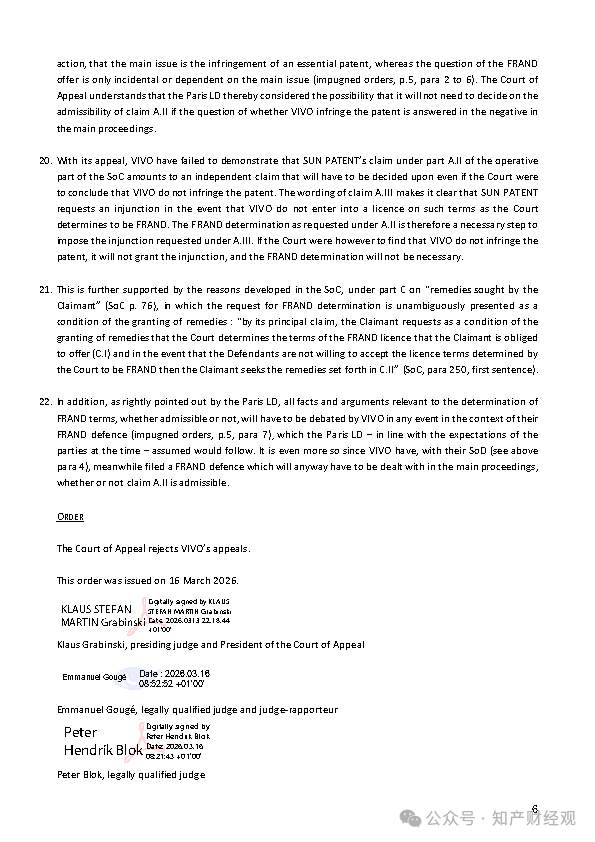
The appellate court also noted that if Vivo were ultimately found not to have infringed, there would be no need to address the FRAND terms; therefore, deferring the relevant issues to the substantive phase aligns with the principle of procedural economy. Furthermore, given that Vivo had raised the FRAND defense in its answer, the FRAND issue would inevitably need to be addressed during the substantive proceedings, even without considering the plaintiff’s related claims.
Based on the foregoing reasons, the Court of Appeal ultimately dismissed all of Vivo’s appeals and upheld the first-instance court’s approach of consolidating the admissibility issues related to FRAND into the substantive proceedings.
Case Background
On April 18, 2025, SPT filed two patent infringement actions against Vivo’s three entities (its parent company in Dongguan, China; its subsidiary in Düsseldorf, Germany; and its subsidiary in Madrid, Spain) with the UPC Paris Regional Division regarding two 4G+ European patents (EP 3 407 524, EP 3 852 468), against three Vivo entities (the parent company in Dongguan, China; the subsidiary in Düsseldorf, Germany; and the subsidiary in Madrid, Spain) before the Paris Regional Division of the UPC, alleging that Vivo’s terminal products sold in France and Germany infringed its SEPs. SPT also requested the court to confirm that its licensing terms complied with the FRAND principles and sought an injunction should Vivo refuse to grant a license;
On September 29, 2025, Vivo filed a preliminary objection to jurisdiction with the Paris Regional Chamber of the UPC, arguing that SPT’s request to determine the FRAND terms constituted an independent claim that did not fall within the exclusive jurisdiction of the UPC as defined by Article 32 of the Agreement on the Unified Patent Court, and that the UPC lacked the authority to hear the case; simultaneously, Vivo challenged the internal jurisdiction of the Paris Regional Chamber and requested the court to dismiss SPT’s claims;
On October 30, 2025, the Paris Regional Division of the UPC ruled to dismiss Vivo’s preliminary objection to jurisdiction, deciding to reserve the issue of the admissibility of the FRAND clause claim for consideration in the substantive proceedings, and granted Vivo leave to appeal the ruling in accordance with the law;
On December 18, 2025, information from the National Intellectual Property Administration indicated that Vivo filed a request for declaration of invalidity regarding SPT’s Chinese 4G invention patent ZL201280024074.8 (Resource Allocation for Single and Multi-cluster Transmission);
On March 16, 2026, the UPC Court of Appeal issued a final ruling: dismissing all of Vivo’s appeals, upholding the ruling of the Paris Regional Division of the first instance, confirming that the admissibility of the FRAND-related issues would be considered as part of the substantive proceedings, clarifying that the UPC Panel has the authority to make such case management decisions, and stating that the FRAND claim is an incidental issue to the infringement claim rather than an independent claim.