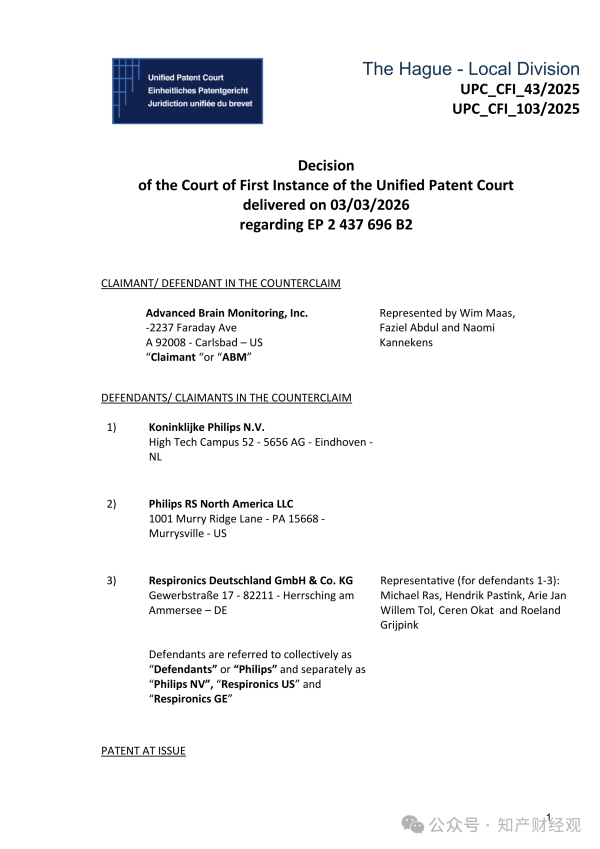
On March 3, 2026, the Hague Division of the Unified Patent Court (UPC) recently issued a final judgment in the patent infringement case brought by Advanced Brain Monitoring (hereinafter referred to as “ABM”) against Philips. The involved patent EP2 437 696 B2 was invalidated, and all infringement claims by ABM were dismissed. It is understood that Philips has become the first party in UPC judicial practice to achieve simultaneous success in both offensive and defensive permanent injunction claims, as well as in patent revocation assertions and defenses.

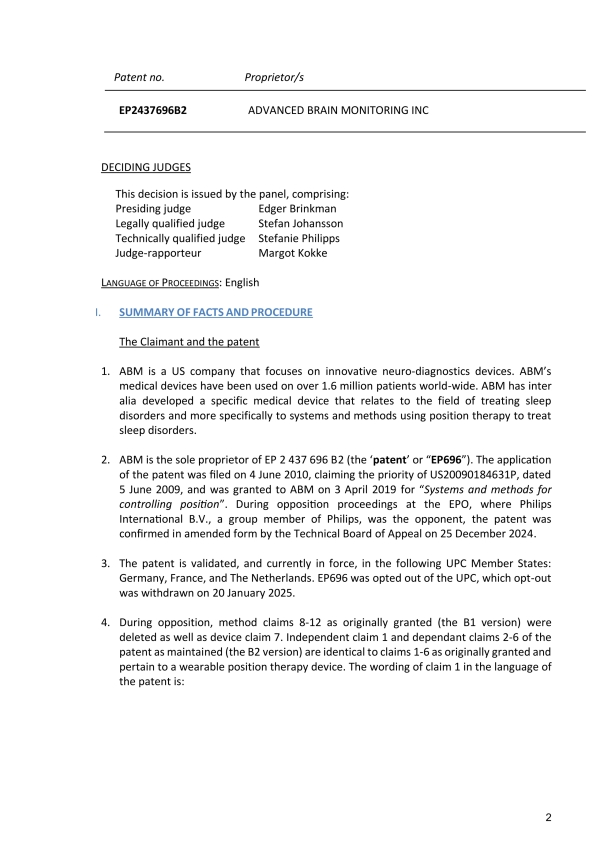
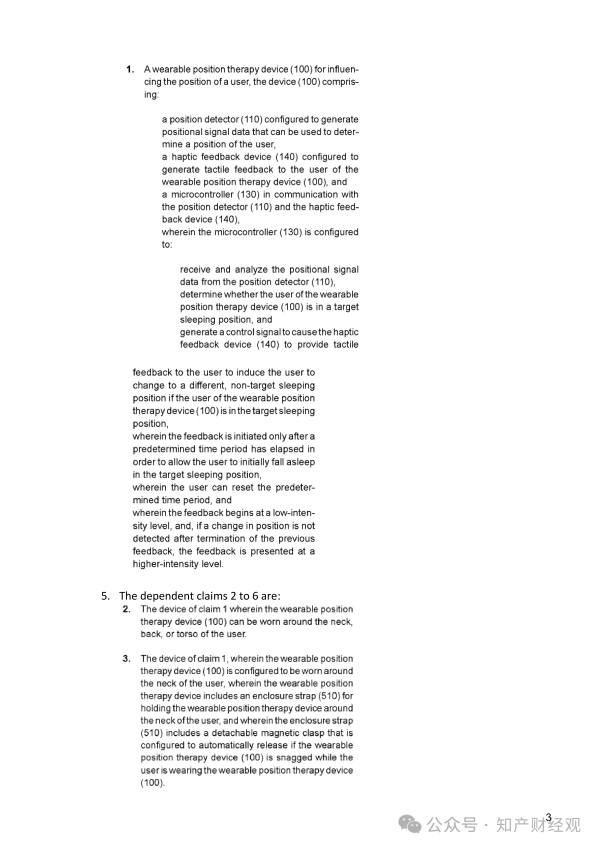
The patent at issue in this case, EP2 437 696 B2, pertains to a wearable positional therapy device specifically designed for patients with sleep apnea. It utilizes position detectors to identify supine sleeping positions detrimental to the condition. Plaintiff Advanced Brain Monitoring alleged that Philips' NightBalance position therapy device infringed claims 1, 2, and 4 of this patent, demanding the court immediately declare Philips' infringement, issue permanent injunctions prohibiting infringement in UPC member states where the patent is valid (Germany, France, Netherlands), simultaneously demanding Philips surrender and destroy infringing products, recall sold products, disclose relevant commercial information, issue an infringement statement, compensate for economic losses, and bear all litigation costs.

In response to ABM's infringement allegations, Philips denied liability and filed a counterclaim, asserting that EP 2 437 696 B2 lacks novelty and inventive step. It requested the court to revoke the patent in its entirety and order ABM to bear the counterclaim costs.

The court determined that the patent in question suffered from significant validity defects: A 1991 Japanese patent application (JP H03-49748 A) fully disclosed all technical features of claims 1 and 2 of EP 2 437 696 B2, thereby rendering the relevant patent claims non-novel. The feature of “providing adaptive feedback based on user response” mentioned in Claim 4, while not directly disclosed in JP748, constituted a routine technical improvement within the art by upgrading the basic circuit of JP748 to a microcontroller with memory in 2009, and thus also lacked inventive step.

Ultimately, the court invalidated the entire EP 2 437 696 B2 patent, upheld Philips' counterclaim, and dismissed ABM's infringement allegations. The judgment further stipulated that ABM must pay Philips €39,000 each for litigation costs related to the infringement suit and the patent revocation counterclaim (including €56,000 in mutually agreed attorney fees and €11,000 in court filing fees per party, split 50:50). This cost award is enforceable immediately upon judgment.

Attached Judgment

...

Scan QR code to access full text