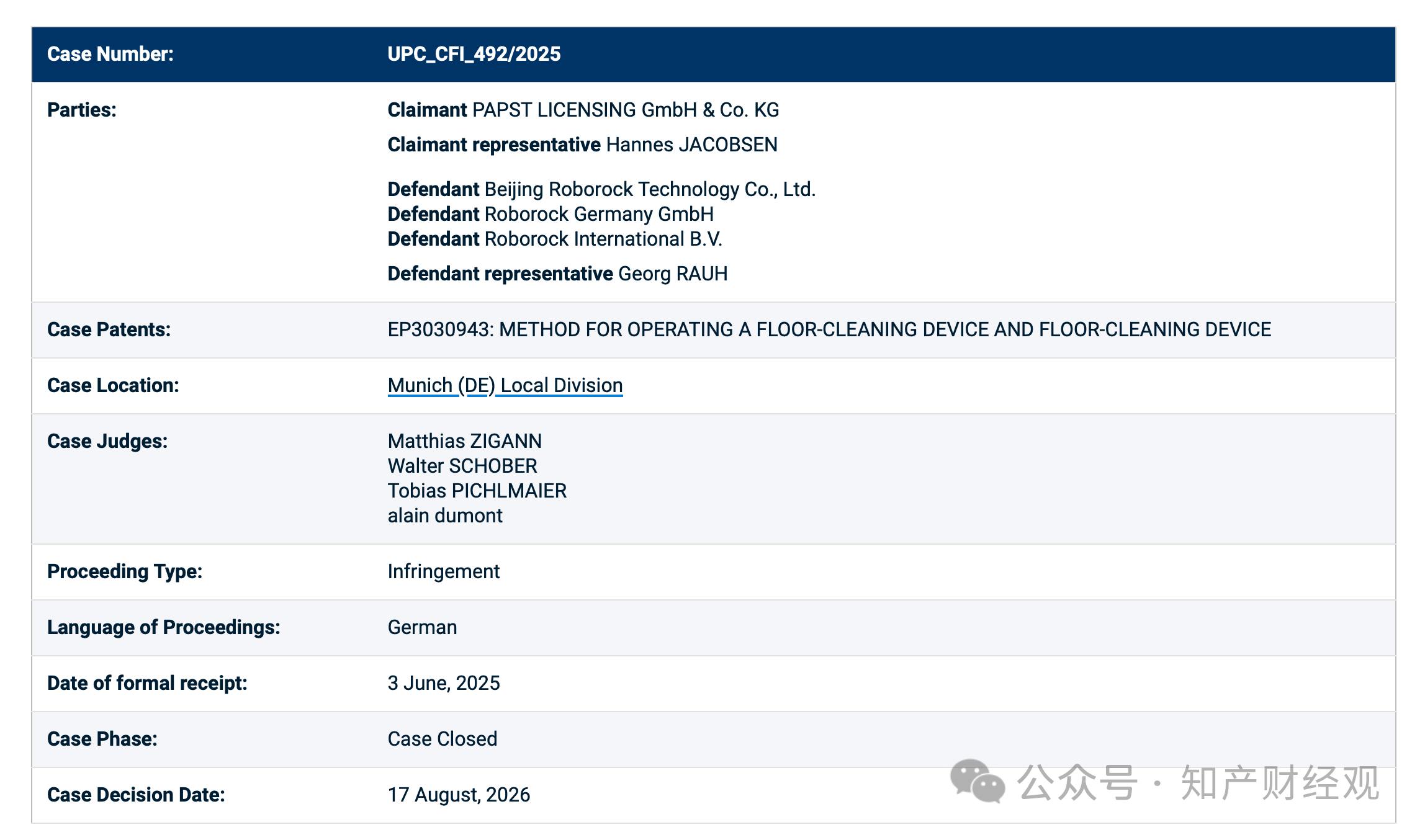
On August 17, 2026, the Munich Division of the Unified Patent Court (UPC) dismissed the patent infringement lawsuit filed by the patent licensing company Papst Licensing GmbH & Co. KG against Beijing Roborock Century Technology Co., Ltd. (Roborock) and its affiliated companies in Germany and the Netherlands, ruling that Roborock’s Roborock S8, Saros 10, and other robotic vacuum cleaner products did not infringe the European patent EP 3 030 943 at issue.
Case Background
The patent at issue in this case is EP 3 030 943, which primarily relates to a technical solution for robotic vacuum cleaners to perform cleaning tasks based on room information. The patent was acquired by the plaintiff, PAPST, in 2024 from the German company RoTrade Asset Management GmbH.
PAPST Licensing GmbH & Co. KG is a patent holder (NPE) entity headquartered in Germany. According to public records, PAPST has signed more than 160 licensing agreements to date, with its licensees encompassing nearly all global hard disk drive manufacturers and most brushless DC fan manufacturers. The company has also filed lawsuits in U.S. courts against technology giants such as IBM, Seagate, Canon, Nikon, Samsung, and Western Digital, with most of these cases ultimately concluding through settlements or licensing agreements. In recent years, the company has expanded its enforcement efforts to include patents acquired through acquisitions, such as the 2023 lawsuit against Samsung in the U.S. District Court for the Eastern District of Texas (which was later settled) and the current case filed against Roborock at the Unified Patent Court (UPC) based on a robotic vacuum cleaner patent acquired in late 2024.
On June 3, 2025, PAPST filed a lawsuit against Beijing Roborock Technology and its German and Dutch subsidiaries, alleging that Roborock’s S8, Q, Qrevo, and Saros series of robotic vacuum cleaners infringed upon the patent rights of EP 3 030 943 in Germany and France.
Key Issues
To prove infringement, PAPST conducted practical tests on two Roborock models currently sold by Roborock—the S8 and Saros 10—and submitted the test videos to the court.
The videos show that after receiving a cleaning task, the robot first performs localization. During this process, it compares features such as walls, corners, and floors captured by its sensors with the map stored in its memory to determine which room it is in. This step precisely corresponds to the requirement in the patent to “determine whether the current room is the designated room.” When the robot is in the same room as the one specified in the task, it begins cleaning on the spot; when it cannot reach the target room, it does not perform the cleaning and returns to the charging dock. PAPST argues that this precisely fulfills the patent’s requirement to “not execute the task upon detecting a mismatch in the room,” and that both robots fully implement the patented solution, thereby constituting infringement.
Stone Technology, however, argues that its products utilize coordinate-based SLAM positioning and navigation technology; the robot merely determines its own coordinates and calculates a path to the target area, while the room divisions displayed in the app are for user reference only. The robot does not perform the “room comparison” required by the patent. As for the task not being completed, this is due to obstacles along the way or the target area being inaccessible, and is unrelated to whether “the room is correct.”
The Court’s Ruling
The crux of this case lies in how the court interprets two technical features in the claims of the patent in question. The Munich Regional Court held that Claims 1 and 10 do not require a robotic vacuum cleaner to simply “know where it is,” but rather that this determination must directly determine whether the task continues. The court summarized this technical logic as an “IF…THEN…” relationship in programming: if the determination is that the robot is “not in the designated room,” this determination must directly result in the interruption or termination of the corresponding cleaning task.
The court further pointed out that the test videos of the Roborock S8 and Saros 10 submitted by the plaintiff only demonstrated that the robots could perform map-based positioning and navigate to target areas. However, these functions could be achieved either through coordinate-based SLAM positioning and navigation logic or through the room- and feature-based map required by the patent in question; therefore, this fell far short of the standard of necessity required to establish infringement.
Taking one set of tests as an example, the robot was placed in Room 3, and the user instructed it to clean Room 2. After localizing its position, the robot did not stop but instead planned a route and attempted to navigate to Room 2; if Room 2 was accessible, it would clean as usual; only when it could not reach Room 2 would it abandon the task and return to the charging dock. Based on this, the court determined that the direct cause of the Roborock product ceasing cleaning was “the target room being inaccessible,” which falls under path planning and reachability issues, rather than the “stopping upon entering the wrong room” required by the patent; the control logic for the two is not the same.
The court specifically pointed out that the termination of a cleaning task due to factors such as closed doors, obstacles, or the inability to calculate a navigation path essentially constitutes path planning or an assessment of target accessibility, rather than the “negative determination” required by the patent in question. Therefore, even if Stone Technology’s robots can identify their current location, plan a route to the target, and stop cleaning when the target is unreachable, this alone does not constitute infringement of the patent in question.
Accordingly, the court ultimately ruled that Stone Technology’s accused products, including the S8 and Saros 10, did not constitute infringement. Consequently, the procedural conditions attached to Stone Technology’s prior counterclaim for invalidation were not met, and the court did not proceed with further review of whether the patent in question lacked novelty or inventive step or involved improper expansion of scope.
Full text of the judgment attached