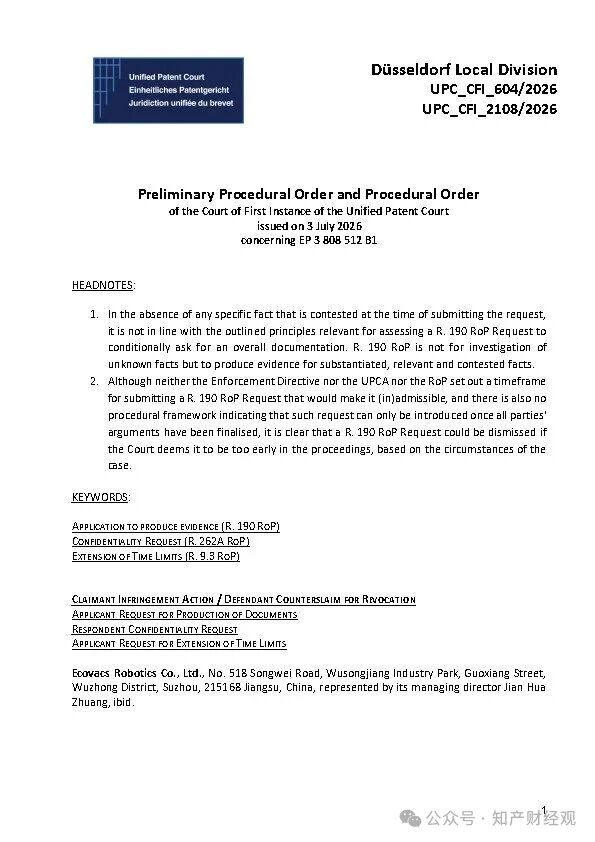
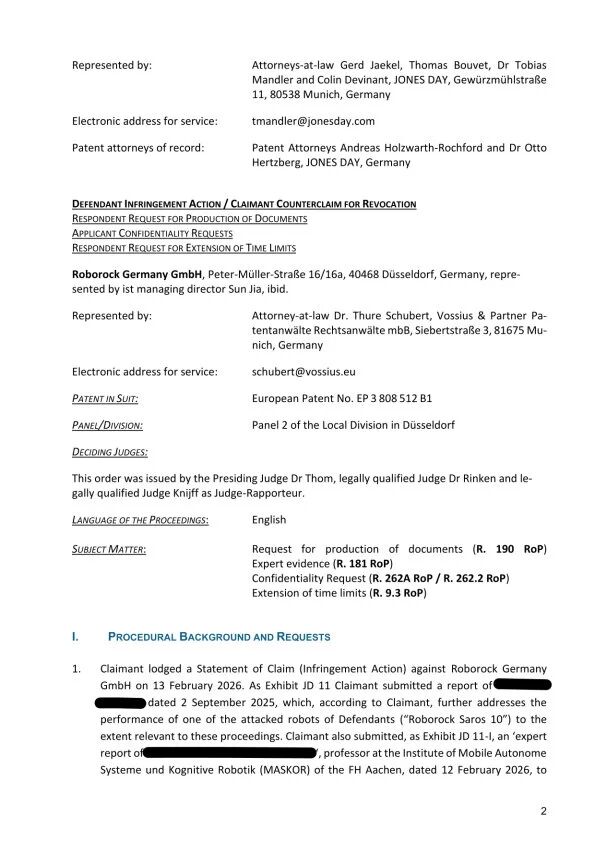
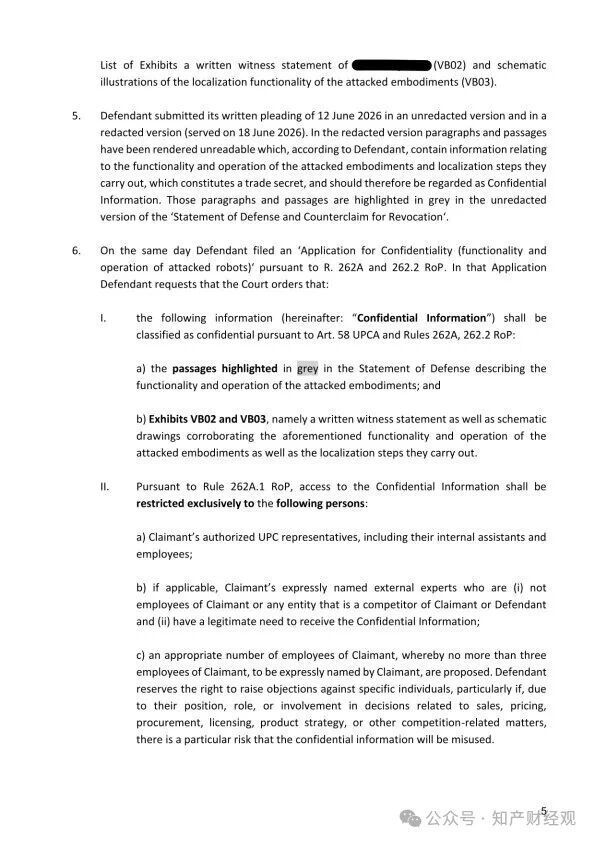
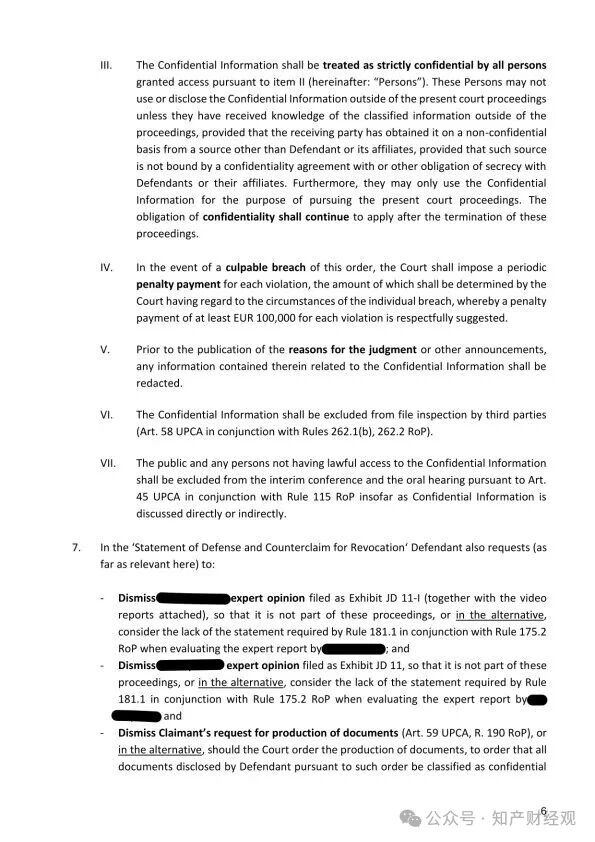
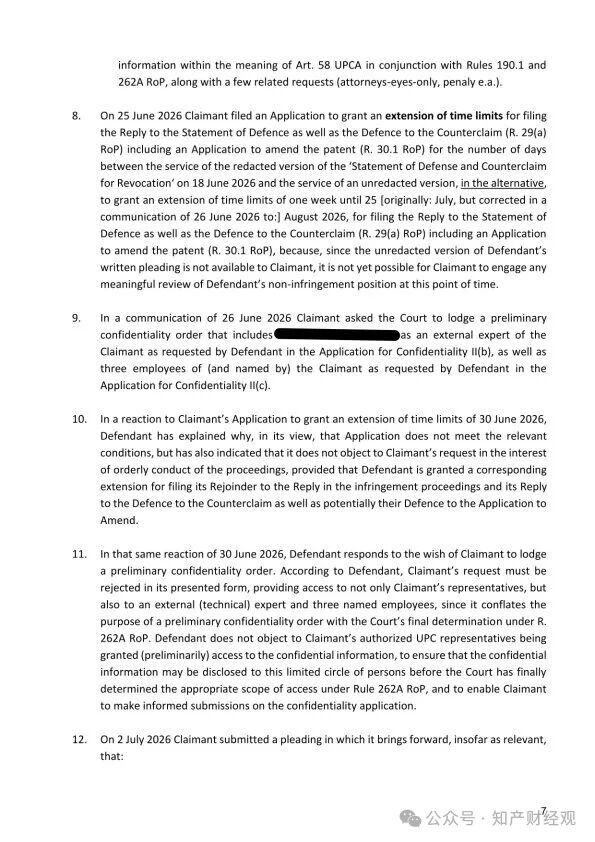
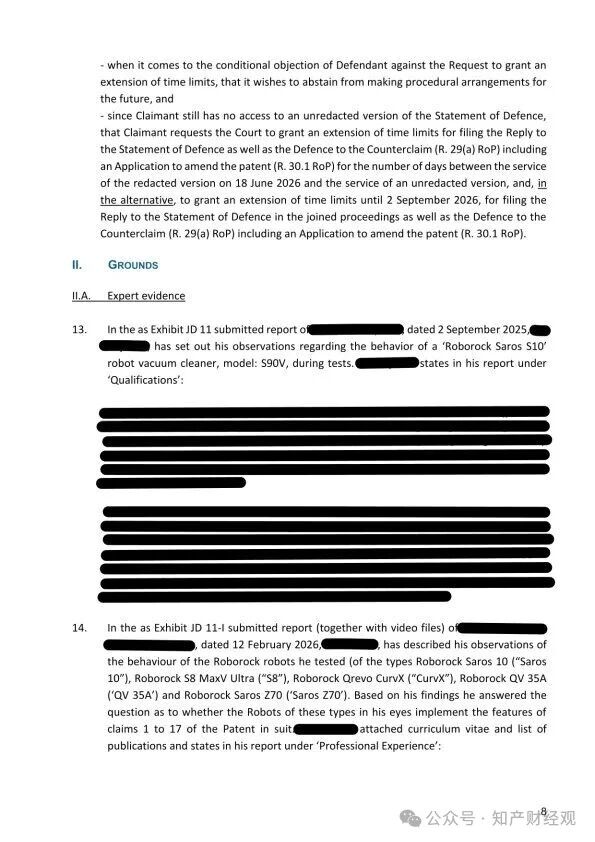
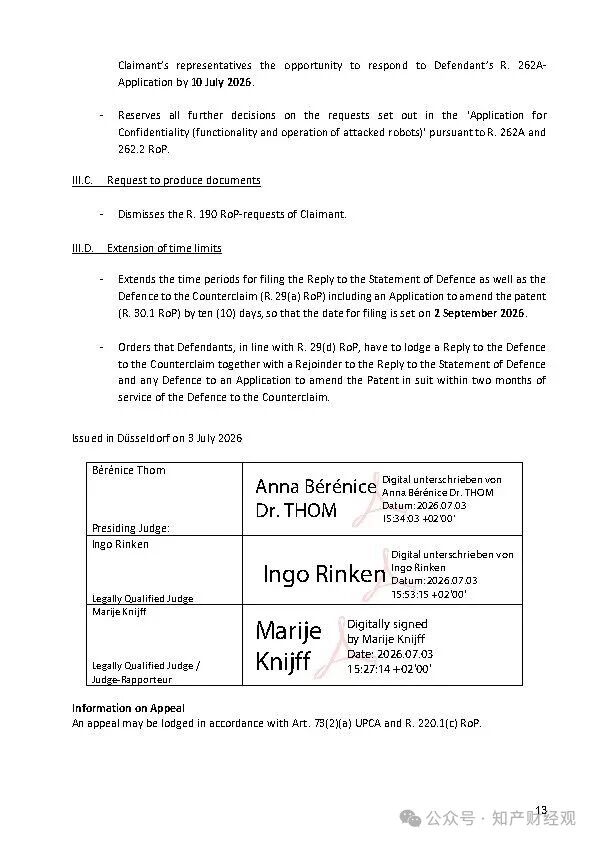
On 3 July 2026, the Düsseldorf Regional Division of the Unified Patent Court (UPC) issued a new procedural order in the patent infringement case between Ecovacs Robotics and Roborock, rejecting Ecovacs’ application for the disclosure of evidence.
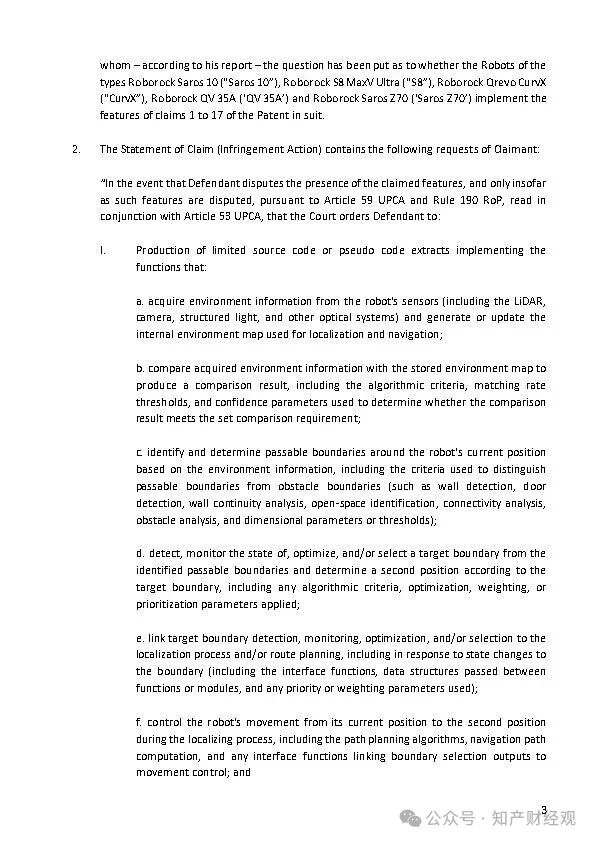
The patent in question, EP 3 808 512 B1, entitled ‘Method for Robot Localisation, Robot and Storage Medium’, relates to a method for re-localising a robotic vacuum cleaner following displacement or ‘hijacking’, comprising technical steps such as environmental data collection, map comparison, identification and selection of navigable boundaries, path planning and attitude confirmation.
Ecovacs had previously brought a patent infringement action against Roborock’s German subsidiary at the Düsseldorf Chamber, alleging that several robotic vacuum cleaner models—including the Roborock Saros 10, S8 MaxV Ultra, Qrevo CurvX, QV 35A and Saros Z70—infringed the patent. Stone Technology promptly filed a defence and lodged a counterclaim seeking the invalidation of the patent, arguing that the positioning methods used in the products in question do not fall within the specific steps defined in the claims.
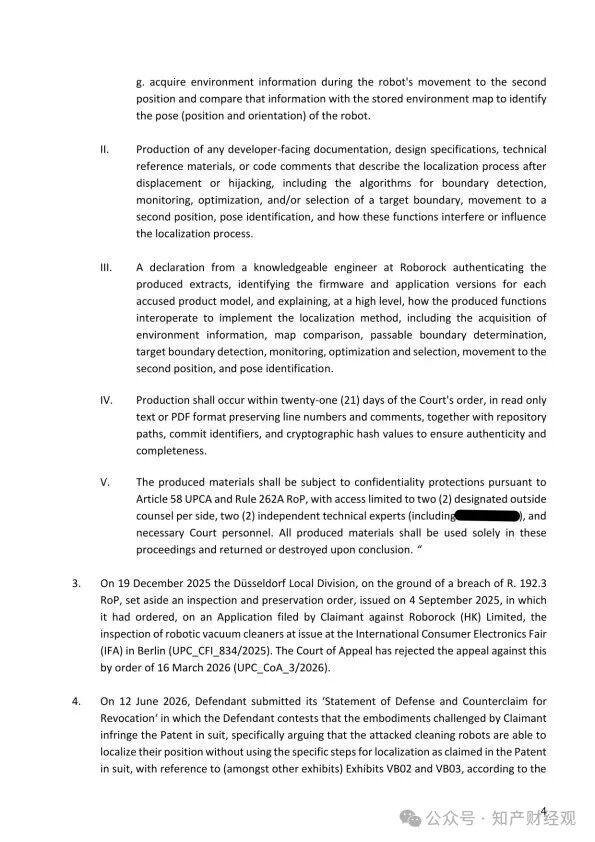
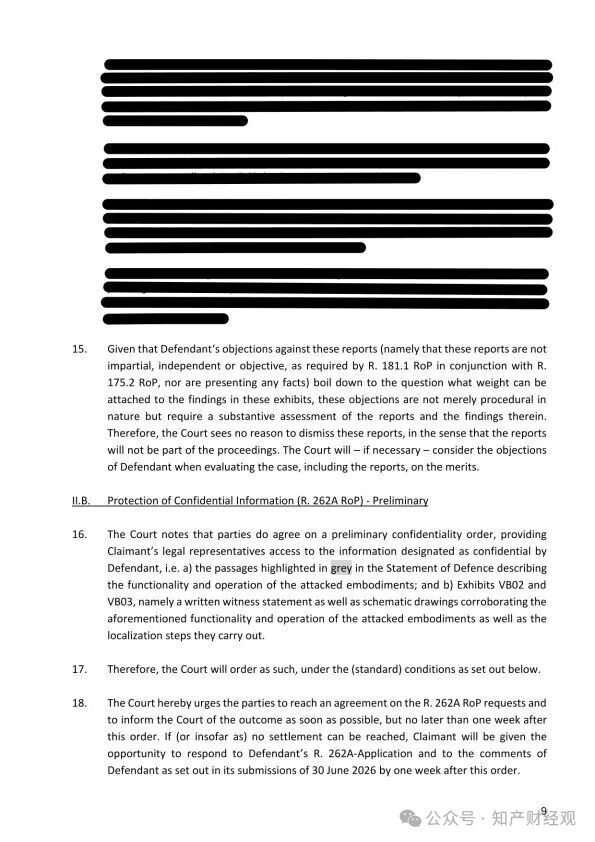
This order primarily concerns the application for the disclosure of source code. According to public documents, the materials that Ecovacs requested the court to order Roborock to disclose mainly relate to the software implementation of robot navigation and positioning, including source code or pseudocode corresponding to functions such as environmental data collection, map generation and updating, environmental matching algorithms, identification of navigable boundaries, selection of target boundaries, path planning and robot movement control.
In response to this application, Stone Technology argued that it neither met the requirements of the UPC Agreement and the UPC Rules of Procedure nor complied with the principle of proportionality, and therefore constituted an abuse of process. Stone Technology contended that it had already provided a detailed explanation of the positioning method employed by the accused product in its defence and counterclaim for invalidation, and had submitted written evidence in support thereof; consequently, there was no evidential gap that required the court to order the further disclosure of source code to be proven.
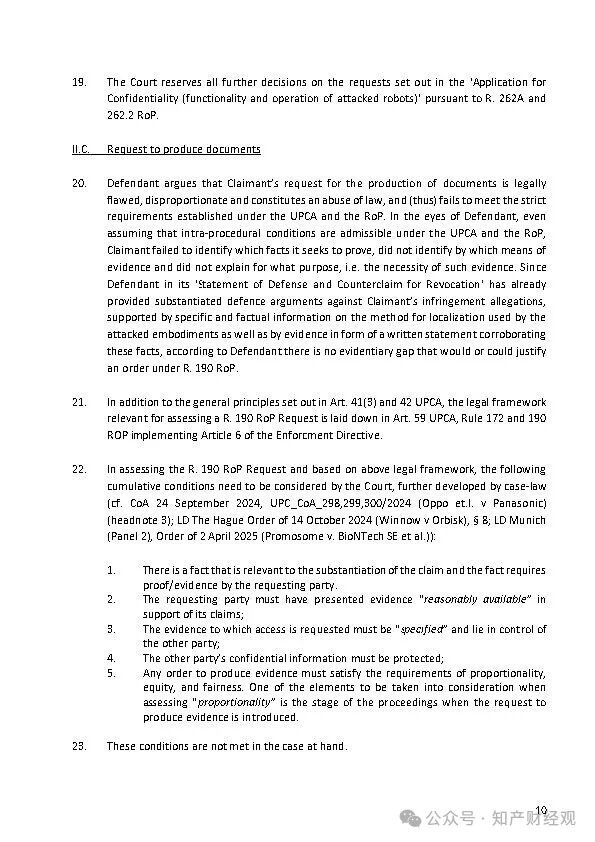
In its ruling, the court summarised the five cumulative conditions that must be met for an application to produce evidence under Article 190 of the UPC Rules of Procedure, including: the fact to be proven must be relevant to the case and require proof; the applicant has provided reasonably obtainable preliminary evidence; the evidence sought must be specific and clearly defined and under the control of the opposing party; the opposing party’s trade secrets must be adequately protected; and the order for disclosure must comply with the principles of proportionality, fairness and procedural justice, with the stage of the proceedings being one of the factors to be considered under the principle of proportionality.
The court held that Ecovacs’ application in this instance did not meet the above requirements.
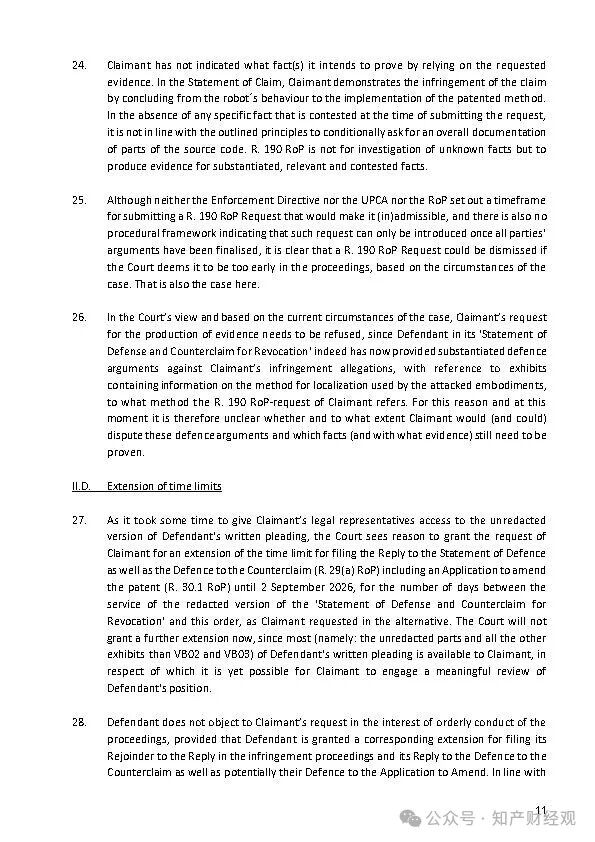
On the one hand, Ecovacs did not specify which particular facts it intended to prove by obtaining the source code; its infringement claim was primarily based on inferring that the robot had infringed the patent in question through its external behaviour, rather than seeking evidence regarding specific facts that were already in dispute. The court pointed out that the purpose of Article 190 is not to investigate unknown facts, but to provide evidence in support of facts that have been specifically alleged, are relevant and are in dispute; therefore, the opposing party should not be required, on a conditional basis, to disclose the source code documentation in its entirety.
On the other hand, Stone Technology has already submitted specific technical descriptions and relevant evidence regarding its positioning method in its statement of defence and counterclaim for invalidation. At present, it is not possible to determine whether Ecovacs will raise new disputes regarding these defences, nor is it possible to ascertain which facts still require further evidence; consequently, it is premature to require disclosure of the source code at this stage. Accordingly, the court dismissed Ecovacs’ application for the production of evidence.
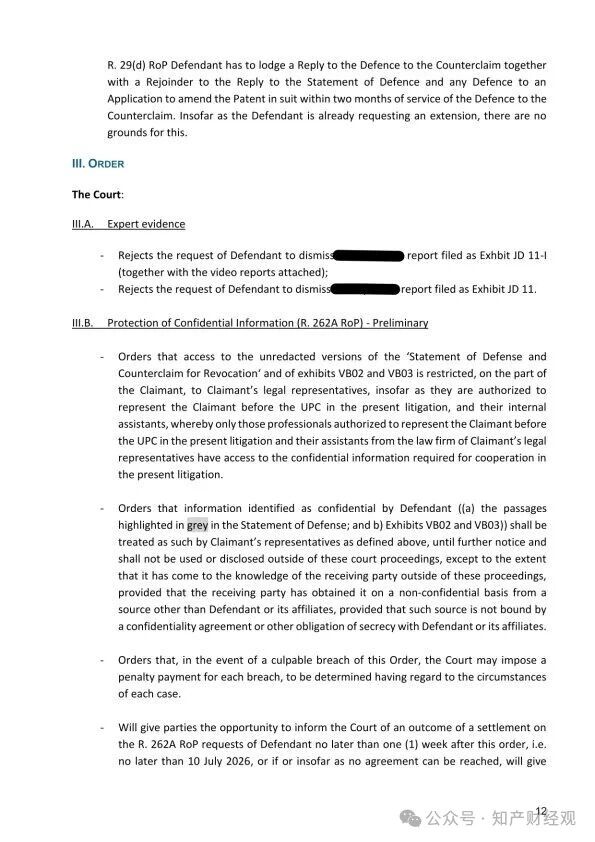
Furthermore, taking into account the delay experienced by Ecovacs’ legal representatives in obtaining the unredacted version of the defence materials, the panel of judges has extended the deadline for Ecovacs to submit its reply to the infringement defence and its defence to the counterclaim for invalidation (including the application for patent amendment) by 10 days, with the new deadline set for 2 September 2026; The deadline for Roborock to submit subsequent reply documents remains the standard two months as stipulated in Rule 29(d), and the court rejected its request for a further extension.
Case Background
On 27 August 2025, Ecovacs filed a lawsuit in the United States District Court for the Eastern District of Texas against Roborock and its subsidiaries, alleging that its S8 MaxV Ultra robotic vacuum cleaner infringed US Patent No. US11,850,753;
On 3 September 2025, Ecovacs filed a claim against Roborock at the Düsseldorf Regional Division of the Unified Patent Court (UPC), alleging infringement of patent EP3808512B1 in the European market (Case No.: ACT_36001/2025);
On 4 September 2025, the Düsseldorf Regional Division of the UPC issued an order for the preservation of evidence and an on-site inspection based on Ecovacs’ unilateral application (Case No.: UPC_CFI_834/2025);
On 7 October 2025, Roborock Technology’s application for a provisional injunction at the First Regional Court of Munich, Germany, was granted, prohibiting Ecovacs from selling the DEEBOT N20 PLUS/PRO PLUS in Germany in relation to patent EP3231340 (Case No.: 21 O 12347/25);
On 13 October 2025, Roborock was again granted a provisional injunction by the First Regional Court of Munich, Germany, restricting the sale of several Deebot N20 series products by Ecovacs in Germany (Case No.: 7 O 12785/25);
On 19 December 2025, the Düsseldorf Regional Division of the Unified Patent Court (UPC) ruled that the ex parte order it had issued on 4 September was unlawful and formally revoked the order (Case No.: UPC_CFI_834/2025);
On 13 February 2026, Ecovacs filed a patent infringement action against Roborock Germany GmbH at the Düsseldorf Division, alleging that several Roborock robotic vacuum cleaner models, including the Saros 10, S8 MaxV Ultra, Qrevo CurvX, QV 35A and Saros Z70, among other robotic vacuum cleaner models, infringed the patent (Case No.: UPC-CFI-0000604/2026);
On 16 March 2026, the UPC Court of Appeal set aside the ex parte interim injunction sought by Ecovacs against Roborock Technology, finding that Ecovacs had failed to fulfil its obligation to fully disclose material facts, which constituted an abuse of process;
On 12 June 2026, Roborock Technology filed a statement of defence and brought a counterclaim for patent invalidity, arguing that the positioning method of the products in question did not fall within the specific steps defined in the claims.
Attached: Ruling